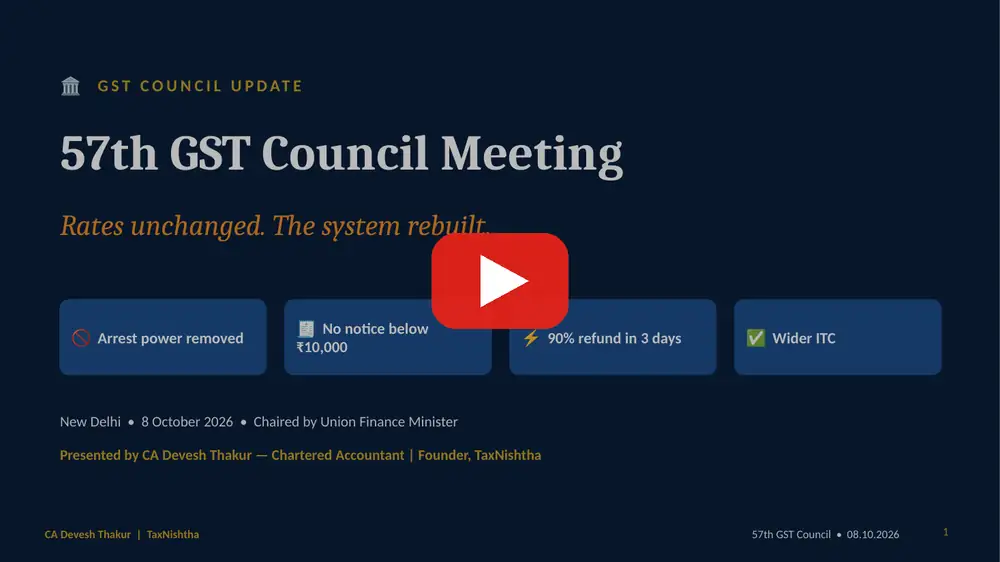
The 57th GST Council meeting was held in New Delhi on 8 October 2026. This time, not a single GST rate changed. But what did change is bigger than a rate change: the power of arrest is being removed, notices below ₹10,000 will stop, 90% of refunds will be sanctioned by the system in three working days, and the door is opening for ITC on insurance, free samples and expired stock. One important item, which affects every purchaser, was deferred.
Read this first: recommendation vs law
Everything in this article is a recommendation of the GST Council. The law changes only when the CGST/IGST Act is amended (realistically through the next Finance Act) or a notification or circular is issued.
Until then, the existing law continues to apply. Only a few dates were stated in the official outcome note, such as 1 November 2026 and 1 April 2027.
A full “What applies when” table is given near the end.
WhatsApp Channel for notes and updates on GST, Income Tax, TDS, TCS, Export and Accountancy: whatsapp.com/channel/0029Va6GOVE9MF92Ylmo7e0L
57th GST Council Meeting: 12 Big Decisions at a Glance
| Area | Recommendation |
|---|---|
| Arrest power | Removed from GST |
| Prosecution threshold | ₹1 crore → ₹5 crore |
| General penalty | ₹25,000 → ₹10,000 |
| Small notices | None below ₹10,000 |
| Refunds | 90% by the system in 3 working days |
| Input services | Inverted duty refund for credit from 1.11.2026 |
| Plant & machinery | Refund for credit from 1.4.2027 |
| ITC | Widened: insurance, samples, towers and more |
| Registration | Auto-approval and auto-amendments |
| Goods in transit | Checks only by source and destination States |
| Export of services | Foreign branch billing counts as export |
| E-commerce | ECO warehouse can be declared as PPOB |
One Year of GST 2.0: The Report Card
The meeting began with a report card. The 5%, 18% and 40% structure came in from 22 September 2025 and has now completed a year:
- Monthly taxable supply grew 25.8%, and supplies reported to consumers rose 26.7%, which means B2C reporting has improved.
- The effective tax rate on domestic supply fell from 14.55% to 13.13%.
- GST revenue in FY 2026-27 is up 11%, and 14.7% for June to August 2026.
Rates went down and the base went up. That is why the Council now treats the rate structure as stable, and the focus has shifted to how GST works day to day: registration, returns and refunds.
No Rate Change — and Rates Only Once a Year
No rate was changed at this meeting. Going forward, rate matters will be taken up only once a year, in a separate dedicated meeting, and the Finance Minister said rate decisions will take effect from 1 April. For businesses, this means stability and certainty: no mid-year repricing of products, invoices or ERP masters.
Decriminalisation: Arrest, Prosecution and Penalty
| Area | Section | Before | After (recommended) |
|---|---|---|---|
| Power of arrest | Sec. 69 | Officers could arrest | Removed from GST |
| Prosecution threshold | Sec. 132 | ₹1 crore | ₹5 crore |
| Minimum punishment | Sec. 132 | 6 months minimum | Removed — fine, jail or both left to the court |
| General penalty | Sec. 125 | Up to ₹25,000 | Up to ₹10,000 |
| Late filing / mistakes | — | Fear of criminal action | Recovery + interest + proportionate penalty only |
The general penalty under Sec. 125 applies where no other specific penalty is provided. The Finance Minister clarified that arrest is being taken out of the tax officer’s hands, but criminal prosecution will remain in the GST law.
Why Now? Detection Replaces Deterrence
The system now matches seller and buyer invoice by invoice, so fake credit is caught where it is created. These capabilities did not exist when the law was framed in 2017. Enforcement will now run on detection, not fear.
Status
Arrest, prosecution and penalty changes all need an amendment to the CGST Act through Parliament, realistically via the next Finance Act. Until then, the existing law stays in force.
Litigation: No GST Notice Below ₹10,000
No notice will be issued where the amount is below ₹10,000. The Finance Minister said that pending notices below this threshold will also be withdrawn. A common standard for the Centre and States will also be framed for: how notices are issued and served, how pre-notice intimation is given, when fraud can be alleged, how hearings are conducted, and how orders are written.
Return-Mismatch Notices: A Data-Entry Problem
Around 95,000 system-generated notices go out every year on return differences, and the recovery is only 0.08%. In other words, it is almost entirely a data-entry problem. So:
- If a supplier reduces something reported earlier, he will do it in his sales statement, so that the change reaches the buyer who took the credit.
- Corrections for earlier periods will be allowed, and a wrongly typed buyer GSTIN can be fixed.
- The credit will settle through the Invoice Management System (IMS): what the buyer accepts goes into his return.
GST Refunds: 90% in 3 Working Days
| Step | Now | Recommended |
|---|---|---|
| Acknowledgement of refund claim | 15 days | 10 days — deemed acknowledged if no acknowledgement or deficiency memo |
| Provisional 90% refund | 7 days | 3 working days from acknowledgement, sanctioned by the system on risk assessment |
| Excess balance in electronic cash ledger | Officer | Automatic — no officer role |
Shipping details will come into the claim form from Customs and payment details from the banking system. About 65% of refund claims relate to exports or inverted duty, and 55% of them are already low-risk; 19% are only for cash-ledger balances — money the government already holds.
New Refunds: Input Services and Plant & Machinery
| Refund now covers | What changes | Applies to credit availed |
|---|---|---|
| Input services (inverted duty) | Until now, inverted duty refund was limited to goods. Tax paid on input services will also be refundable. | On or after 1 November 2026 |
| Plant & machinery (exporters and inverted duty) | Fully excluded until now. Refund at 1/60th of the credit per month, matching the asset’s working life. | On or after 1 April 2027 |
In simple words, when a manufacturer sets up a new production line, its tax credit will no longer lie idle in the credit pool. Pharma, FMCG and exporters will see better working capital.
Registration and Closure Go Automatic
- Low-risk applicants, and those whose output tax liability is up to ₹2.5 lakh per month, get registration from the system in 3 working days, without an officer. 61% of registrations already come through this route.
- The application form will guide you: show only the fields that apply to you and explain what each document is for.
- From November 2025 to September 2026, 16.73 lakh amendment applications came in; 10.95 lakh (65.45%) were for trade name, directors/partners or the address of an additional place of business. These will now be accepted automatically.
- Closure will be automated in stages, starting with smaller taxpayers. The final return becomes part of the closure application, not a separate step.
- If the system suspended or cancelled a registration for a missing return or bank details, it will restore it automatically once the gap is fixed.
Annual Return for the Smallest B2C Taxpayers
An optional scheme has been approved in principle for taxpayers with turnover up to ₹5 crore who supply only to consumers: they will file one return a year and pay tax quarterly. Of the roughly 1.05 crore active taxpayers, an average of about 16.85 lakh report only such supplies; 99% of them are below ₹5 crore and together pay less than 1% of total liability. The detailed framework will come at the next meeting.
Goods in Transit: Checks Only at Origin and Destination
A vehicle can be stopped only on specific intelligence, and the decision must be authorised in advance by a Joint Commissioner or above. Only the source and destination States can inspect; States on the route cannot stop the vehicle. Earlier, a consignment crossing five States could be checked in each of them. The document is still required and will be matched in the system; the only change is that a physical check now follows information, not the other way round.
ITC Widened under Sec. 17(5)
| Item | Earlier | Recommended | Who gains |
|---|---|---|---|
| Employee health & life insurance | Blocked — Sec. 17(5)(b) | Credit allowed | All employers |
| Telecom towers | Disputed as immovable property | Credit allowed | Telecom |
| Pipelines laid outside the factory | Disputed as immovable property | Credit allowed | Oil, gas, chemicals |
| Free samples | Blocked — Sec. 17(5)(h) | Credit allowed | Pharma, FMCG |
| Expired stock destroyed as required by law | Reversal required | Credit allowed | Pharma, food |
Honest buyer: a Committee of Officers will study how to protect a genuine buyer who holds a proper invoice, has received the goods and has paid the supplier in full. It will complete the study in three months, and the agenda will come to the next Council meeting.
No Double Tax on Resold Services
Where a service is bought and resold in the same line of business, tax will now apply once, not twice. Common instances are hotels up to ₹7,500 per night booked through an agent, restaurant and catering services, and passenger transport. Credit was denied earlier because these are supplied at 5% without credit; now the credit chain will continue. This is important for tour operators and travel agents.
Export of Services: Wider Export Status
- Billing through your own branch abroad: an Indian firm serving foreign clients through its foreign branch will get the export benefit; the condition that blocked it is being removed. Analytics firms, design studios, engineering consultancies and India offices of global companies all benefit.
- Work in India on a foreign client’s goods: testing, repair, certification, research or processing will be treated as export of service, even though the goods never leave India.
- Payment realisation: when an export payment is treated as received will follow RBI rules — one standard instead of two.
Together with the refund changes, service exporters will get back the tax paid on their costs faster.
E-commerce: Small Sellers Can Sell Across States
Selling in a State needs registration there, which a small seller often cannot manage, so he stays limited to his home State. Now he can declare the e-commerce operator’s warehouse in another State as his principal place of business, and the operator’s consent will be given automatically by the system. The conditions:
- At least one State with physical presence, which remains the home State.
- One registration per PAN per State, limited to sales through the platform.
- Over 90% of platform sellers pass less than ₹2.5 lakh of credit per month, so the facility is opened for them; sellers who cross this go to ordinary registration.
One tax rule for every platform: platforms were reading the same provisions differently, so the same delivery carried different tax. Now, tax on a booking will follow the service actually delivered — same delivery, same tax. Some reports mention a rate cut from 18% to 5% for services of unregistered delivery riders, but this is not in the official note; whether the operator or the supplier pays will be clear only from the notification.
Deferred: What Did NOT Change
Sec. 16(2)(c): the supplier’s default
On 24 July 2026, the Supreme Court in Bhandari Scrap Traders upheld Sec. 16(2)(c) as constitutionally valid. This means that if the supplier does not deposit the tax, ITC can be denied even to a genuine buyer. If the supplier pays later, ITC can be re-availed (Sec. 41). The Council’s agenda had an amendment to protect genuine buyers, but according to reports, it was deferred and referred to a GoM over concerns of misuse through fake billing. For now, only the Committee of Officers will be formed, and a decision will come at the next meeting.
Motor vehicle ITC: Sec. 17(5)(a)
The motor-vehicle ITC proposal was also deferred (reports). The existing rule continues: ITC stays blocked on vehicles with seating capacity of up to 13 persons, except for specified uses such as further supply, passenger transport, driving training and goods transport.
Your protection until then
Vendor compliance: monthly IMS and GSTR-2B reconciliation, checking each vendor’s GSTR-3B status, and keeping proof of payment.
What Applies When
| Decision | Route (expected) | Date / status |
|---|---|---|
| Rate review once a year | Council policy | Next decision effective 1 April |
| Arrest / prosecution / ₹10,000 penalty | CGST Act amendment | Await Finance Act |
| No notice below ₹10,000 | Rules + instructions | Await notification / circular |
| Refund: 10-day ack, 90% in 3 days, auto cash ledger | Rules + system | Await notification |
| Input-services refund (inverted duty) | Act / Rules | Credit on or after 1 Nov 2026 |
| Plant & machinery refund (1/60 per month) | Act / Rules | Credit on or after 1 Apr 2027 |
| ITC widening under Sec. 17(5) | Act amendment | Await Finance Act |
| Foreign branch / foreign goods = export | IGST Act amendment | Await Finance Act |
| ECO warehouse as PPOB; transit checks | Rules + system | Await notification |
| Sec. 16(2)(c) protection · motor vehicle ITC | Deferred | Next meeting / existing rule continues |
Dates are shown only where they appear in the official outcome note or the Finance Minister’s briefing.
5 Action Points for Businesses and Accountants
- Don’t change price lists or billing masters — there was no rate change.
- Tighten vendor compliance — Sec. 16(2)(c) still applies in full.
- Track input-service ITC separately from 1 November 2026 if you are in an inverted duty business.
- Map your export contracts — identify work billed through a foreign branch or done on foreign clients’ goods.
- List pending notices below ₹10,000 and match them as soon as the circular is issued.
Rates stayed the same, but the system is brand new. Watch for the notifications and the Finance Act amendments as they come.
Frequently Asked Questions
When was the 57th GST Council meeting held?
The 57th GST Council meeting was held in New Delhi on 8 October 2026, chaired by the Union Finance Minister.
Did the 57th GST Council change any GST rates?
No. No GST rate was changed. The 5%, 18% and 40% structure continues, and rate matters will now be taken up once a year in a dedicated meeting, with decisions effective from 1 April.
Has the power of arrest been removed from GST?
The Council has recommended removing the power of arrest under Sec. 69 of the CGST Act. It needs an amendment to the CGST Act, expected through the next Finance Act. Until then, the existing law continues.
What is the new prosecution threshold under GST?
The Council has recommended raising the prosecution threshold under Sec. 132 from ₹1 crore to ₹5 crore, and removing the minimum six-month punishment. This also requires an amendment to the Act.
Will GST notices be issued for amounts below ₹10,000?
As recommended, no notice will be issued where the amount is below ₹10,000, and pending notices below this threshold are to be withdrawn. Watch for the notification or circular implementing it.
What changes were recommended for GST refunds?
Refund acknowledgement within 10 days instead of 15 (deemed acknowledged otherwise), 90% provisional refund sanctioned by the system within 3 working days of acknowledgement, and automatic refund of excess balance in the electronic cash ledger.
From when will inverted duty refund be available on input services?
The refund of tax paid on input services under the inverted duty structure is recommended for credit availed on or after 1 November 2026. Refund on plant and machinery, at 1/60th of the credit per month, is recommended for credit availed on or after 1 April 2027.
Which ITC restrictions under Sec. 17(5) are being relaxed?
The Council has recommended allowing ITC on employee health and life insurance, telecom towers, pipelines laid outside the factory, free samples, and expired stock that the law requires to be destroyed. These need an amendment to the Act.
What was deferred at the 57th GST Council meeting?
Protection for genuine buyers against the supplier’s default under Sec. 16(2)(c) and the motor-vehicle ITC proposal were deferred, according to reports. The existing rules continue for both.