
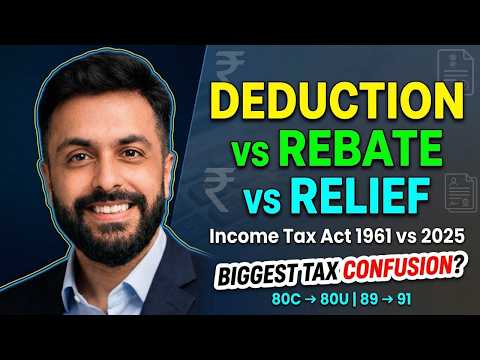
From 1 April 2026, the Income-tax Act, 2025 replaces the Income-tax Act, 1961 for tax years beginning on or after that date. That change has prompted a practical question: have familiar deductions such as 80C, 80D, NPS and housing-loan benefits disappeared? The short answer is that many provisions have been reorganised and renumbered, while eligibility, limits and conditions still need to be checked under the applicable law and tax regime. The old section numbers also remain relevant for earlier tax years and pending matters.
WhatsApp Channel for notes and updates on GST, Income Tax, TDS, TCS, Export and Accountancy: whatsapp.com/channel/0029Va6GOVE9MF92Ylmo7e0L
What has changed under the new Income Tax Act?
The new Act changes the structure and numbering of several provisions that individuals, businesses and tax professionals have long known by their 1961 Act section numbers. The familiar topics remain important, but a taxpayer dealing with a tax year beginning on or after 1 April 2026 will need to refer to the corresponding provision in the 2025 Act.
This does not mean every old section number should be used for every return filed after that date. The relevant Act depends on the tax year concerned. For example, income for FY 2025–26, reported in AY 2026–27, continues to be governed by the 1961 Act; tax years beginning from 1 April 2026 fall under the new Act.
The sections discussed in the video cover three broad areas:
- Personal deductions, including savings, insurance, education and housing.
- Profit-linked deductions and incentives for eligible businesses and institutions.
- Rebates and reliefs, including relief for salary arrears and double taxation.
Section 122: The framework for claiming deductions
The video begins with a central principle: calculate gross total income before applying deductions. A deduction cannot be used to claim more than the income available for the relevant computation, and the same income cannot ordinarily be deducted twice under different provisions.
For profit-linked deductions, compliance is part of the claim. The video stresses filing the return by the prescribed due date, claiming the deduction correctly, maintaining separate books where required, and keeping transactions between eligible and non-eligible businesses at appropriate market values. These rules are intended to prevent the artificial shifting or inflation of profits to obtain a tax benefit.
The Income Tax Department’s current FAQs also confirm that timely return filing is a statutory condition for specified deductions under section 122, and that safeguards against artificially inflating eligible profits continue under the new Act.
Section 123: The new reference for familiar 80C investments
Section 80C is one of the most widely used provisions under the old Act. Under the new Act, its corresponding provision is section 123. The Income Tax Department confirms that the aggregate deduction of ₹1.5 lakh for specified savings and payments remains structurally similar for individuals and HUFs, with eligible items placed in Schedule XV. The deduction is not available under the new tax regime in section 202.
The video discusses the familiar qualifying payments, including life insurance premiums, provident fund contributions, Public Provident Fund, ELSS, tuition fees for eligible children, home-loan principal repayment, National Savings Certificates, five-year tax-saving deposits and Sukanya Samriddhi deposits.
A few details matter when reviewing a claim:
- For eligible life insurance policies, the premium-to-sum-assured condition may affect the deduction.
- Tuition-fee claims are for tuition fees, not every charge collected by a school or college.
- The home-loan principal deduction is subject to the applicable conditions, including the relevant holding period.
- A pension-plan contribution discussed under section 80CCC forms part of the shared ₹1.5 lakh ceiling; it is not a separate additional limit.
The practical point is to total up eligible contributions already made through salary, provident fund and loan repayments before making another investment solely for a deduction.
Section 124: NPS contributions
The video groups the NPS provisions under section 124, corresponding to section 80CCD of the old Act. It distinguishes between an individual’s own contributions and an employer’s contribution.
The contribution under section 80CCD(1) was subject to the overall savings limit described above. The additional contribution under section 80CCD(1B) was discussed as a separate deduction of up to ₹50,000, taking the potential combined deduction for eligible personal contributions to ₹2 lakh, subject to the law and the chosen tax regime.
Employer contributions under section 80CCD(2) work differently. The video highlights that the deduction is calculated with reference to salary and the applicable percentage limit, rather than being restricted to the general ₹1.5 lakh savings ceiling. It also notes that this employer-contribution deduction may remain available under the new regime, subject to the prescribed conditions.
Section 125: Agniveer Corpus Fund contributions
Section 80CCH is mapped in the video to section 125. It concerns eligible individuals enrolled in the Agnipath Scheme who contribute to the Agniveer Corpus Fund.
The video explains that the deduction relates both to the eligible individual’s own contribution and the Central Government’s matching contribution. It is treated separately from the section 80C savings limit. Eligibility, contribution records and the precise statutory conditions should be checked before claiming it.
Section 126: Health insurance and medical expenses
The video identifies section 126 as the new reference for section 80D. The deduction is based on who is covered by the policy and their age. It discusses limits for the taxpayer, spouse and dependent children, as well as a separate limit for parents, with higher limits where senior citizens are involved.
Preventive health check-up expenses may be included within the applicable overall limit. The video also notes that qualifying medical expenses for a senior citizen without health insurance may be considered under the provision.
Payment method is important: the video says health insurance premiums should be paid through a mode other than cash, while preventive health check-up payments may be made in cash. Since the limits and precise conditions depend on the taxpayer’s situation, check the current provision before filing.
Sections 127 and 128: Disability and specified medical treatment
Section 127: Maintenance of a dependent with a disability
The video maps section 80DD to section 127. It describes a fixed deduction for an eligible taxpayer who maintains a dependent with a disability. The amount depends on the disability category, rather than the exact amount spent, and a valid medical certificate is essential.
Section 128: Treatment of specified diseases
Section 80DDB is discussed as section 128. The video explains that a deduction may be available for eligible treatment expenses, subject to a statutory cap. Any insurance reimbursement or employer reimbursement reduces the amount that can be claimed. The required medical certificate must come from an appropriately qualified specialist.
Section 129: Interest on an education loan
The video maps section 80E to section 129. The deduction discussed is for interest paid on an eligible education loan, not repayment of the principal. It applies to qualifying higher education and eligible borrowers, such as the taxpayer, spouse or children, subject to the provision’s conditions.
The video describes an eight-year claim period beginning with the year in which interest repayment starts. It also notes that the deduction is associated with the old tax regime. Confirm the current provision and regime eligibility before claiming it.
Sections 130 and 131: Housing-loan interest deductions
The video covers two housing-loan provisions:
- Section 130, corresponding to section 80EE, for eligible first-time home buyers who meet the property value, loan amount and loan-sanction conditions.
- Section 131, corresponding to section 80EEA, for qualifying affordable housing loans, subject to its own property, loan and date conditions.
These are time-bound provisions. The video explains that section 80EE’s additional interest deduction was available only where the prescribed conditions were met, and that section 80EEA could not be claimed for the same loan if the section 80EE benefit had already been claimed. It also points out that these deductions are not available under the new tax regime described in the video.
Verify the loan-sanction window and eligibility conditions from the law before relying on either deduction.
Section 132: Interest on a loan for an electric vehicle
The video maps section 80EEB to section 132. It discusses a deduction for interest on a qualifying loan taken by an individual to purchase an electric vehicle, subject to a maximum amount and a specified loan-approval period. It also says the benefit was limited to new vehicles and was not available to companies or firms.
The loan-approval dates should be checked against the applicable provision before making a claim.
Section 133: Donations under section 80G
The video explains section 80G through four broad categories: donations eligible for 100% or 50% deduction, and donations in each category that are subject to a qualifying limit. The recipient fund or institution and the payment method determine the treatment.
For donations subject to a limit, the video outlines a calculation based on adjusted gross total income. The qualifying limit is generally 10% of the relevant adjusted gross total income; eligible donations are then considered in the order required by the provision. Cash donations above the statutory threshold are not eligible for deduction, so the receipt and payment record should be retained.
Do not assume every charitable donation qualifies. Check the recipient’s status and the applicable category before claiming.
Sections 134 and 135: Rent and research donations
Section 134: Rent paid where HRA is not received
Section 80GG is mapped to section 134. The video describes this deduction for eligible taxpayers who do not receive house rent allowance, subject to conditions concerning the taxpayer’s and family’s ownership of residential property in the relevant location.
It presents the deduction as the least of three amounts: a fixed monthly limit, a percentage of adjusted total income, and rent paid less a specified percentage of adjusted total income. Form 10BA is also mentioned. Verify the current statutory amount and conditions before claiming.
Section 135: Donations for scientific research and rural development
The video maps section 80GGA to section 135. It discusses eligible donations for scientific research, social science research and rural development, and notes that the provision is generally relevant to taxpayers without business or professional income.
The video also stresses using traceable payment methods and retaining supporting documents. Its reference to digital reporting and verification reflects the increased importance of matching donation details with the recipient’s reporting.
Sections 136 and 137: Political contributions
The video discusses political contributions separately for companies and other eligible taxpayers:
- Section 136 is described as the new reference for section 80GGB, covering qualifying contributions by Indian companies to registered political parties or electoral trusts.
- Section 137 is described as the corresponding provision for section 80GGC, covering qualifying contributions by eligible persons other than companies.
The video says cash contributions do not qualify and that the recipient must meet the statutory definition. Keep the contribution receipt and payment evidence, and verify whether the chosen tax regime permits the deduction.
Sections 138 to 143: Business, infrastructure and regional incentives
These provisions concern specific businesses and undertakings. They are not general deductions available to every taxpayer.
Section 138: Infrastructure and power undertakings
The video maps section 80-IA to section 138 and discusses eligible infrastructure facilities, power businesses, telecommunications, industrial parks and SEZ-related businesses. It describes deductions linked to eligible profits, available for a prescribed number of years, with requirements such as separate books, audit documentation and market-value pricing for transfers between businesses.
Section 139: SEZ developers
Section 80-IAB is discussed as section 139. The video describes a profit-linked deduction for qualifying SEZ developers, subject to the applicable notification, development-period and return-filing conditions.
Section 140: Eligible start-ups
The video maps section 80-IAC to section 140. It discusses a 100% deduction of eligible profits for three consecutive years chosen within a prescribed period, for qualifying start-ups that meet recognition, incorporation, turnover and innovation conditions.
Section 141: Specified industrial undertakings
Section 80-IB is mapped to section 141. The video describes benefits for specified businesses, including certain undertakings in backward areas, mineral-oil operations and eligible food-processing activities. It refers to different deduction rates and periods depending on the activity.
Eligibility is activity-specific and should be checked against the applicable provision.
Section 142: Housing projects
The video maps section 80-IBA to section 142. It discusses deductions for eligible affordable or rental housing projects, subject to approval dates, completion deadlines, plot size, carpet-area limits and restrictions on commercial space.
The video also warns that if a project fails to meet a completion condition after a deduction has been claimed, the earlier benefit may be withdrawn and taxed as required by law.
Section 143: Specified North-Eastern undertakings
Section 80-IE is discussed as section 143. The video describes an incentive for eligible businesses in specified North-Eastern states, subject to the business start date and the nature of the activity. It mentions manufacturing, substantial expansion and certain eligible services.
This is a legacy, date-bound incentive. A business must verify both the state and the statutory commencement conditions before assuming it qualifies.
Section 144: SEZ units
The video maps section 10AA to section 144 and explains that the benefit is relevant to qualifying existing SEZ units. It describes an export-profit deduction phased across different periods and emphasises that the calculation applies to export profits, not automatically to the unit’s entire profit.
The video characterises the new provision as preserving remaining benefits for eligible existing units rather than creating a fresh incentive for new units. The business’s existing claim history and transitional eligibility need careful review.
Section 145: Processing biodegradable waste
Section 80JJA is mapped to section 145. The video discusses eligible businesses that process biodegradable waste to produce power, bio-fertilisers, bio-pesticides, biogas or fuel products. It describes a deduction for eligible profits for a specified number of consecutive years and notes that tax-regime choice can affect availability.
Section 146: Additional employee cost
Section 80JJAA is discussed as section 146. The video describes a deduction linked to eligible additional employee costs, potentially available across multiple years. It highlights conditions concerning the employee’s service period, salary, payment through banking channels and provident fund compliance.
The precise employee thresholds and qualifying-period rules must be checked before a claim is made.
Section 147: Banking and IFSC units
The video maps section 80LA to section 147. It discusses qualifying offshore banking units and IFSC units, eligible income, possible deduction periods and documentation such as audit reports and regulatory approvals.
Section 148: Inter-corporate dividends
Section 80M is discussed as section 148. The video explains that a domestic company receiving a dividend may claim a deduction linked to the dividend it distributes onward, subject to the amount and timing conditions. The same dividend cannot be used for a duplicate deduction.
Section 149: Co-operative societies
The video maps section 80P to section 149. It discusses deductions for qualifying co-operative society income from activities such as member credit facilities, cottage industries, agricultural supplies, certain produce, warehousing and interest or dividends from another co-operative society.
Not every co-operative society qualifies. The video specifically cautions that a co-operative bank operating like a commercial bank may fall outside the benefit.
Sections 151 to 154: Royalties, interest and disability
Section 151: Royalty income of authors
The video maps section 80QQB to section 151. It discusses eligible resident individual authors of qualifying literary, artistic or scientific works, subject to exclusions and a deduction cap. It also notes documentation requirements and conditions where royalty is received from outside India.
Verify the cap from the provision before use.
Section 152: Royalty income of patent holders
Section 80RRB is mapped to section 152. The video describes a deduction for eligible resident individual inventors who earn royalty from a qualifying patent, subject to a cap and documentation requirements. Commercial profits from selling products made using the patent are distinguished from royalty income.
Section 153: Interest on deposits
The video groups sections 80TTA and 80TTB under section 153. It distinguishes the deduction for savings-account interest available to eligible non-senior taxpayers from the broader interest deduction described for senior citizens, which may include fixed and recurring deposits.
The video states that these deductions depend on opting for the old regime or opting out of the default regime. Check the precise scope and limit under the applicable Act.
Section 154: Deduction for a taxpayer with a disability
Section 80U is mapped to section 154. The video describes a fixed deduction for a resident individual with a medically certified disability, with a higher amount for severe disability. A valid certificate from the prescribed medical authority is necessary, and the deduction’s availability depends on the tax regime selected.
Sections 155 and 156: Rebates against tax payable
A deduction reduces income used in the tax calculation; a rebate reduces tax after it has been calculated. The video makes this distinction while explaining the transition from section 87 to section 155 and from section 87A to section 156.
Section 156 is the rebate provision corresponding to section 87A. The Income Tax Department confirms that the rebate cannot exceed the income tax payable before allowing the rebate. The video discusses the ₹5 lakh income threshold and ₹12,500 rebate under one scenario, and the higher limit under the new regime. The exact rebate amount and eligibility depend on the tax year, regime and statutory conditions, so confirm the current figures before filing.
Section 157: Relief when salary or other eligible receipts arrive together
A bonus, salary arrears or an advance payment can push income into a higher tax bracket in the year it is received. The video explains relief for eligible arrears and advance salary, corresponding to section 89 under the old Act.
For tax years under the new Act, the Income Tax Department says section 157 relief is claimed using Form 39. For AY 2026–27, which is governed by the 1961 Act, the old section 89 and Form 10E continue to apply.
Section 158: Foreign retirement accounts
The video discusses section 89A as section 158. It addresses a timing mismatch that can arise when a person becomes resident in India but holds a foreign retirement account that is taxed abroad only on withdrawal.
For eligible individuals and notified countries, the provision allows tax treatment to be aligned with the foreign country’s withdrawal-based system, subject to the prescribed process. The video mentions Form 10EE and examples such as the United States, the United Kingdom and Canada. Check the current notified-country list and filing requirements before relying on this treatment.
Section 159: Relief from double taxation
The final topic is relief where income may be taxed in India and another country.
Under the treaty route discussed in the video, India’s double taxation agreement with another country may provide relief. The video explains that the more beneficial applicable provision may generally be relevant, subject to limitations such as the general anti-avoidance rules and documentation requirements. It also highlights the importance of a Tax Residency Certificate for a non-resident seeking treaty benefits.
Where India has no tax treaty with the other country, the video discusses unilateral relief under section 91 of the 1961 Act, corresponding to section 60 of the 2025 Act. It describes the broad conditions as Indian residency for the relevant tax year, foreign-source income, and tax actually paid abroad. The relief is computed using the applicable statutory method and limits.
What taxpayers should do before claiming a deduction
The main lesson from the video is that old section numbers are still useful for recognising a provision, but they are not enough to establish eligibility for a new tax year. Before filing:
- Identify the tax year and the Act that governs it.
- Match the familiar section to its new provision and any relevant Schedule.
- Check whether the deduction is available under your chosen tax regime.
- Confirm the current limit, eligibility dates and supporting-document requirements.
- File the return by the due date where timely filing is a condition.
- Retain payment proofs, certificates, audit reports and other claim documents.
Final takeaway
The Income-tax Act, 2025 changes how taxpayers locate and apply familiar deductions, rebates and reliefs. Section 80C’s new reference, for example, is section 123, with qualifying payments listed in Schedule XV; the new regime under section 202 does not allow that deduction. Other provisions deal with health costs, education loans, housing, business incentives, royalties, rebates and foreign tax relief.
The safest approach is to check the provision that applies to the specific tax year, rather than relying on an old section number or an isolated limit. This article follows the topics covered in the video and is for general education; individual claims depend on the Act, rules, notifications and facts applicable to the taxpayer.
Primary search phrase: Income Tax Act 2025 deductions