


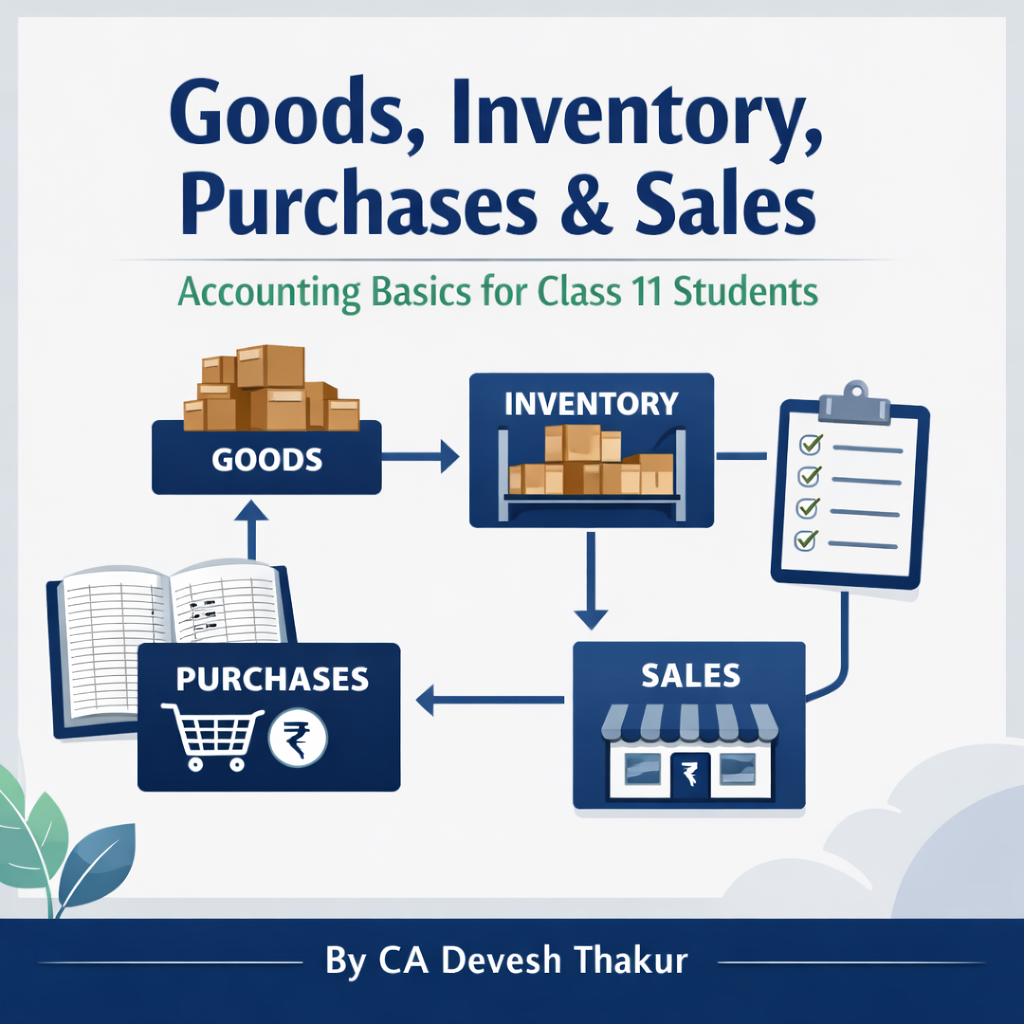
Day 22 of 50 days accounting challenge – By CA Devesh Thakur
Introduction
Accounting begins with understanding a few fundamental concepts. Among them, Goods, Inventory (Stock), Purchases, and Sales form the backbone of financial accounting. These concepts are introduced at the Class 11 level and continue to remain relevant in Class 12, CA Foundation, CUET, and other commerce-related examinations.
This blog provides a clear, detailed, and student-friendly explanation of these concepts with practical examples and an exam-oriented approach to help learners build a strong accounting foundation.
1. Goods in Accounting
Meaning of Goods
In accounting, goods refer to those items which a business purchases or manufactures with the intention of selling.
In simple terms, goods are items:
- Bought for resale, or
- Produced for sale to customers
The purpose of goods is always sale, not use.
Examples of Goods
- Mobile phones for a mobile shop
- Garments for a clothing store
- Furniture for a furniture dealer
Goods vs Assets (Important Distinction)
It is important not to confuse goods with assets.
- Goods are meant for selling
- Assets are meant for use in the business
Example:
- Furniture used in the office → Asset
- Furniture bought for resale → Goods
This distinction is frequently tested in examinations.
2. Inventory / Stock
Meaning of Inventory (Stock)
Inventory, also known as stock, refers to goods that remain unsold with the business at a particular point in time.
In other words, inventory represents the value of goods available with the business.
Inventory is classified into three main categories:
(A) Raw Material
Meaning
Raw material consists of basic materials used in the manufacturing process to produce finished goods.
These materials are not sold directly to customers.
Examples
- Cotton for a garment factory
- Wood for furniture manufacturing
- Steel for utensil production
(B) Work in Progress (WIP)
Meaning
Work in Progress refers to goods that are partially completed but not yet ready for sale.
These goods are still under the production process.
Examples
- Half-stitched garments
- Furniture awaiting polishing
- Bakery items still being baked
WIP represents an intermediate stage between raw material and finished goods.
(C) Finished Goods
Meaning
Finished goods are goods that are completely manufactured and ready for sale to customers.
These goods are the final output of the production process.
Examples
- Ready-made garments
- Fully polished furniture
- Packed food products
3. Purchases
Meaning of Purchases
Purchases refer to the buying of goods by a business for resale or for manufacturing purposes.
Only goods purchased for selling or production are treated as purchases in accounting.
Types of Purchases
- Cash Purchases – Payment is made immediately
- Credit Purchases – Payment is made at a later date
Purchases of assets such as machinery or furniture are not treated as purchases in accounting terms.
Trade Discount
Meaning of Trade Discount
A trade discount is a reduction allowed by the seller on the list price of goods, usually to encourage bulk purchases or trade relations.
Accounting Treatment
- Trade discount is not recorded separately in accounting books.
- Purchases are recorded at the net amount, after deducting trade discount.
Example
List Price: ₹20,000
Trade Discount @10%: ₹2,000
Net Purchase Value = ₹18,000
Only ₹18,000 will be recorded in the books of accounts.
Purchase Journal
Meaning
A Purchase Journal is used to record credit purchases of goods only.
It does not record:
- Cash purchases
- Purchase of assets
Example
Goods purchased on credit from Ram Traders for ₹18,000 will be recorded in the Purchase Journal.
4. Sales
Meaning of Sales
Sales refer to the selling of goods by a business to its customers.
Sales generate revenue for the business and involve the transfer of ownership of goods.
Types of Sales
- Cash Sales – Payment is received immediately
- Credit Sales – Payment is received at a later date
Sales of assets are not treated as sales in accounting.
Sales Journal
Meaning
A Sales Journal is used to record credit sales of goods.
It does not include:
- Cash sales
- Sale of old assets
Example
Goods sold on credit to Mohan for ₹25,000 will be recorded in the Sales Journal.
5. Common Exam-Oriented Clarifications
Purchases vs Inventory
- Purchases represent goods bought during the year
- Inventory represents goods remaining unsold at a particular date
Goods vs Assets
- Goods are meant for sale
- Assets are meant for business use
Understanding these differences helps avoid common examination errors.
Conclusion
A clear understanding of Goods, Inventory, Purchases, and Sales is essential for mastering accounting. These concepts form the foundation for:
- Journal entries
- Trading and Profit & Loss Account
- Final accounts
For Class 11 students, mastering these basics ensures a smooth transition to advanced accounting topics in higher classes and professional courses.
This structured explanation aims to provide clarity, confidence, and conceptual strength to every commerce learner.